
That difference matters, because the two are not interchangeable and the Code asks for different ones in different places.
What the NCC requires
NCC 2022 Volume One, Part F7 covers sound transmission and insulation. Clause F7D6 sets the wall requirements for Class 2 and Class 3 buildings: apartments, hotels and similar.
| Wall | Requirement | Why |
|---|---|---|
| Between sole-occupancy units | Rw + Ctr not less than 50 | Neighbours generate low-frequency noise (entertainment systems, subwoofers), so the spectrum adaptation term is applied. |
| Between a sole-occupancy unit and a plant room, lift shaft, stairway, public corridor or lobby | Rw not less than 50 | These spaces are not likely to produce low-frequency noise, so the base Rw applies. |
Some of those walls also attract a discontinuous construction requirement. Requirements differ by building class, and commercial offices are typically driven by the project’s acoustic report rather than by the Code minimum, so always work from the specification for the job.
Lab numbers are not site numbers
Rw is measured in a laboratory on a wall with no penetrations, no flanking paths and perfect sealing. The equivalent measured on site is lower, and is reported differently: as DnT,w, the field-measured difference between two rooms. A wall specified at Rw+Ctr 50 can measure well below that in place, and the reasons are almost always the same four things.
The four things that actually control performance
| Factor | Effect |
|---|---|
| Mass | Heavier stops more. A second layer of plasterboard is usually the cheapest few points of Rw available. |
| Isolation | Breaking the mechanical path between the two faces (staggered studs, a double stud frame with a gap, or resilient mounting) typically buys more than mass alone. |
| Cavity absorption | Insulation in the cavity damps resonance between the leaves. Density matters, and more is not automatically better; use what the tested system specifies. |
| Sealing | The one that ruins finished jobs. Air paths carry sound. An unsealed perimeter, a gap at the head, or back-to-back power points in the same stud cavity will undo a high-spec wall. |
Of those four, sealing is where site performance is most often lost, and it is the cheapest to get right: acoustic sealant at the perimeter, staggered rather than back-to-back services, and a properly detailed junction where the wall meets the ceiling or the slab.
Acoustic and fire rated are not the same wall
A wall can be rated for fire, for sound, or for both, and the systems that achieve them are not automatically the same. A tested fire rated system does not carry an acoustic rating unless it was also tested for one, and adding mass for acoustic reasons can move a wall outside its tested fire system. Where a wall has to do both, it needs a system tested for both. See fire rated wall systems.
Where acoustic walls get specified
On commercial work the usual drivers are meeting and board rooms, consulting and treatment rooms, tenancy separation, HR and executive offices, and any wall shared with a plant room or lift core. In fit outs, acoustic performance is frequently the difference between a room being usable for its intended purpose and not.
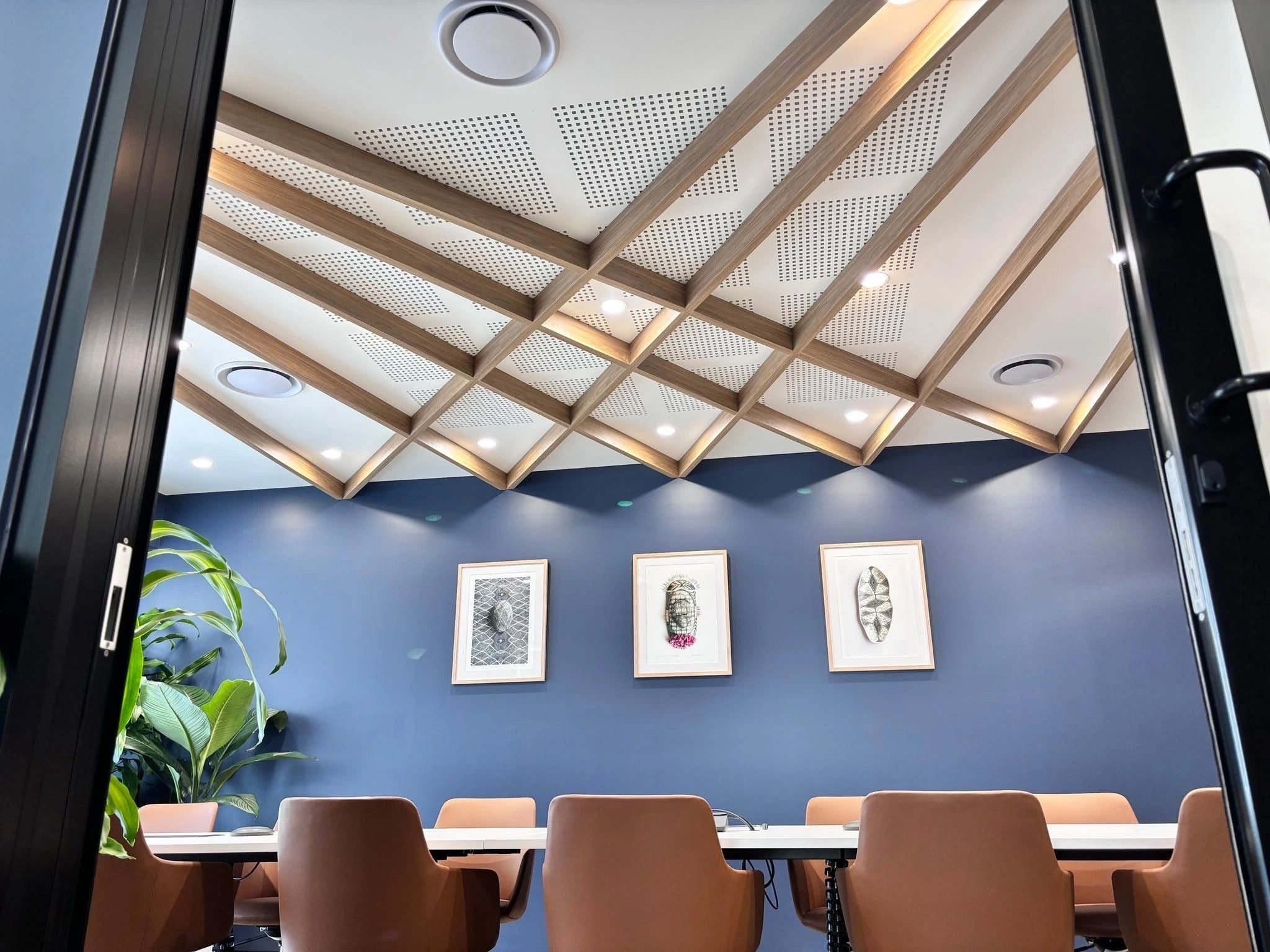
Acoustic ceilings are a separate question again. Perforated acoustic plasterboard and mineral tile systems absorb sound within a room rather than blocking transmission between rooms. See suspended ceilings.
How we build them
Lockbell installs acoustic wall and ceiling systems across the Sunshine Coast, working to the acoustic report and the manufacturer’s tested system. Because so much of the real-world result is in the sealing and the junctions, we detail those deliberately rather than leaving them to the finishing trades.